#TLDR
You can absolutely book hotels with AI today, not just browse options or get suggestions. Modern AI hotel booking apps pull live inventory, show real prices, and complete the reservation in seconds. It works for last-minute trips, specific dates, and specific needs — no 47-tab browsing sessions required. Once you try it, Booking.com starts to feel like a fax machine.
Table of Contents
- What Does It Actually Mean to Book Hotels With AI?
- How Does the Process Work, Step by Step?
- Are the Prices Real? Does It Use Live Availability?
- How Is AI Hotel Booking Different From Booking.com or Expedia?
- Can AI Find Better Hotel Deals?
- Does It Work for Last-Minute Bookings?
- I Switched to BookingGPT — Here's What Happened
- Frequently Asked Questions
What Does It Actually Mean to Book Hotels With AI?
Here's a question I used to get a lot: "Isn't AI just a chatbot that gives you a list of hotels?"
No. That was 2023.
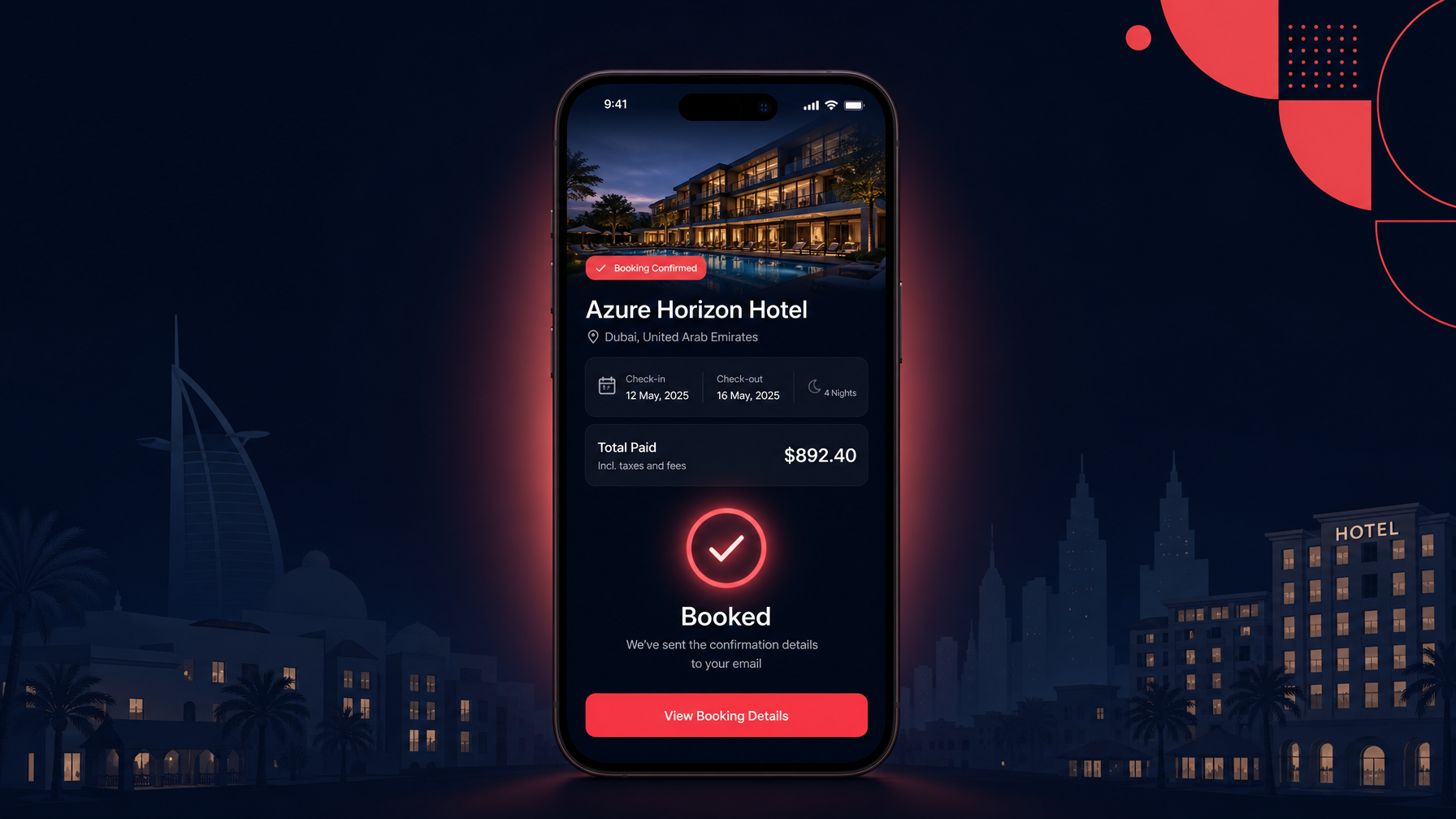
In 2026, when I say I book hotels with AI, I mean the AI actually completes the booking. It searches live inventory, finds real availability for my exact dates, surfaces real prices, and checks me out. I type something like "find me a hotel near the Eiffel Tower under $200 for Friday night" — and within seconds, I have a confirmed reservation.
That's a meaningful distinction. Plenty of tools call themselves "AI" but stop at the inspiration stage. They show you nice photos and vague suggestions, then hand you off to a booking site where the real friction starts: hidden fees revealed at checkout, filters to wrestle with, sold-out rooms that somehow still show up in the results.
Booking hotels with AI means skipping all of that. The AI is the booking engine.
According to a Simon-Kucher survey, 43% of travelers already use AI tools during their hotel search process. The number is growing fast — and the travelers who've made the switch aren't going back to tabbed browser sessions.
How Does the Process Work, Step by Step?
The short version: you describe what you want in plain English, and the AI handles everything else.
Here's how a typical booking session looks when you use an AI-native hotel booking app:
Step 1: Tell It What You Want
No need to fill out a search form with dropdown menus. You just type (or speak) what you're looking for. Something like:
- "King room in Tokyo, check in June 12, check out June 15, under $180 a night"
- "Beach hotel in Miami this weekend, good reviews, free cancellation"
- "Budget hotel near JFK airport tomorrow night"
The AI interprets your request — location, dates, budget, room type, any preferences — and starts searching.
Step 2: The AI Searches Live Inventory
This is the part that separates real AI booking from generic chatbots. The app connects to actual hotel inventory in real time. It's not pulling from a cached database of suggestions. It checks what's actually available, at your actual dates, at the actual current price.
PhocusWire reports that real-time availability access is now a defining feature of next-generation travel AI — one that changes everything about how travelers get and trust pricing information.
Step 3: You See Options and Confirm
The AI surfaces matching options — typically a short, ranked list rather than 400 results you have to filter through. You pick one. You confirm. You're booked.
That's it. Start to finish, under a minute for a clear request.
Are the Prices Real? Does It Use Live Availability?
Yes — and this is a question worth asking, because not all "AI travel tools" pull live data.
The distinction is between tools that use live API connections to hotel inventory systems versus tools that just crawl the web or work from training data. The former gives you real, up-to-date prices and genuine availability. The latter gives you ballpark suggestions that may or may not hold when you actually try to book.
A good AI hotel booking app uses live data. That means:
- The price you see is the price you pay (before taxes/fees, which are disclosed upfront)
- Availability is real — if it shows available, rooms exist
- Pricing reflects current demand, not what the room cost six weeks ago
The Hotels Network's direct booking integration inside ChatGPT, launched in early 2026, is one example of the industry moving toward live, commission-free AI bookings directly within conversational interfaces. The trend is clear: live inventory access is the baseline expectation now.
How Is AI Hotel Booking Different From Booking.com or Expedia?
Let me be direct: Booking.com and Expedia are the old way of doing things. They're powerful aggregators built for a search-and-filter paradigm — one that made sense in 2012 when the alternative was calling a hotel directly.
But the experience hasn't aged well. You know the pattern: open Booking.com, type a city, get 600 results, spend 20 minutes filtering by price, stars, amenities, and cancellation policy, click on three properties, read 47 reviews, second-guess yourself, and eventually book something while quietly wondering if you missed something better.
That's not a travel experience. That's a research project.
Here's how AI hotel booking compares:
| Experience | Old Way (Booking.com / Expedia) | AI Booking |
|---|---|---|
| How you search | Forms, filters, dropdowns | Plain language request |
| Results | Hundreds of options | Curated short list |
| Time to book | 15-45 minutes | Under 2 minutes |
| Availability | Real-time | Real-time |
| Pricing | Real-time, but layered with fees | Upfront |
| Customization | Filter-based | Conversational |
| Last-minute | Works, but chaotic | Works cleanly |
The core difference is interaction model. Booking.com gives you a database to sort. AI booking gives you an assistant that sorts it for you.
According to EHL Research, AI is moving from inspiration to execution in travel — and that shift is fundamentally changing how travelers interact with the booking process. OTAs like Booking.com and Expedia are now scrambling to add AI features onto legacy infrastructure. That's a very different starting point than an app built AI-first from day one.
Can AI Find Better Hotel Deals?
This depends on what you mean by "better."
On raw price alone, major OTAs often have rate parity agreements with hotels — meaning the same room tends to cost the same across Booking.com, Expedia, and most other platforms. That's by design, and it's been a long-standing frustration for travelers.
Where AI booking creates real value is in speed and relevance:
- Speed: You find the right room faster. Less time browsing means less time second-guessing and fewer impulse upgrades that aren't right for your trip.
- Relevance: Because you describe what you want in plain language, the AI matches on intent — not just filters. "Quiet hotel with a good gym" is a natural request an AI handles well. It's a terrible search filter experience.
- Last-minute windows: When prices drop within 24-48 hours of check-in (and they often do), AI apps surface those opportunities quickly. Lighthouse data from March 2026 shows last-minute hotel searches have risen 9% over the past three years — meaning more travelers are leaning into exactly the windows where AI's speed advantage is most valuable.
Does It Work for Last-Minute Bookings?
This is where AI hotel booking genuinely shines.
Last-minute hotel booking on traditional platforms is stressful. You're racing the clock, the filters are less useful because inventory is thin, and the results feel random. You end up booking something decent but not great because you ran out of patience.
With AI, the process is conversational and fast by design. "I need a hotel in Chicago tonight, good location, under $150" — that's a complete request. The AI returns what's actually available at that actual price, ranked by what fits. No dead ends. No "sorry, sold out" after you've already gotten excited.
The Lighthouse 2026 hotel booking trends report notes the global share of hotel searches within 28 days of the stay date has risen significantly, reflecting a broader shift toward flexible, spontaneous booking behavior. AI booking is built for exactly that.
I Switched to BookingGPT — Here's What Happened
I've been using BookingGPT for a while now, and the experience is exactly what I described above — except faster than I expected the first time I tried it.
I typed "hotel in Barcelona, near Las Ramblas, under $160, check in this Friday." The app found live availability, showed me a short list of real options at real prices, and I confirmed one. The whole thing took less than 90 seconds.
What I didn't do: open a browser tab, filter by star rating, scroll through 200 reviews, cross-reference prices on another site, or second-guess the booking for 10 minutes.
BookingGPT is an AI that actually executes hotel bookings — not a chatbot that suggests options and punts you to a booking site. It connects to live hotel inventory, surfaces real availability, and completes the reservation. That's the entire point.
The app is available on both iOS and Android.
If you've been curious about what it actually looks like to book hotels with AI, this is the most direct way to find out. Download BookingGPT here — the first booking will make the old way feel like a lot of unnecessary work.
Frequently Asked Questions
Is it safe to book hotels through an AI app?
Yes, provided the app connects to legitimate hotel inventory systems and processes payments through secure channels. Reputable AI booking apps use the same booking infrastructure as major OTAs — the AI is the interface layer, not a replacement for the underlying booking and payment system.
Do I still get a booking confirmation?
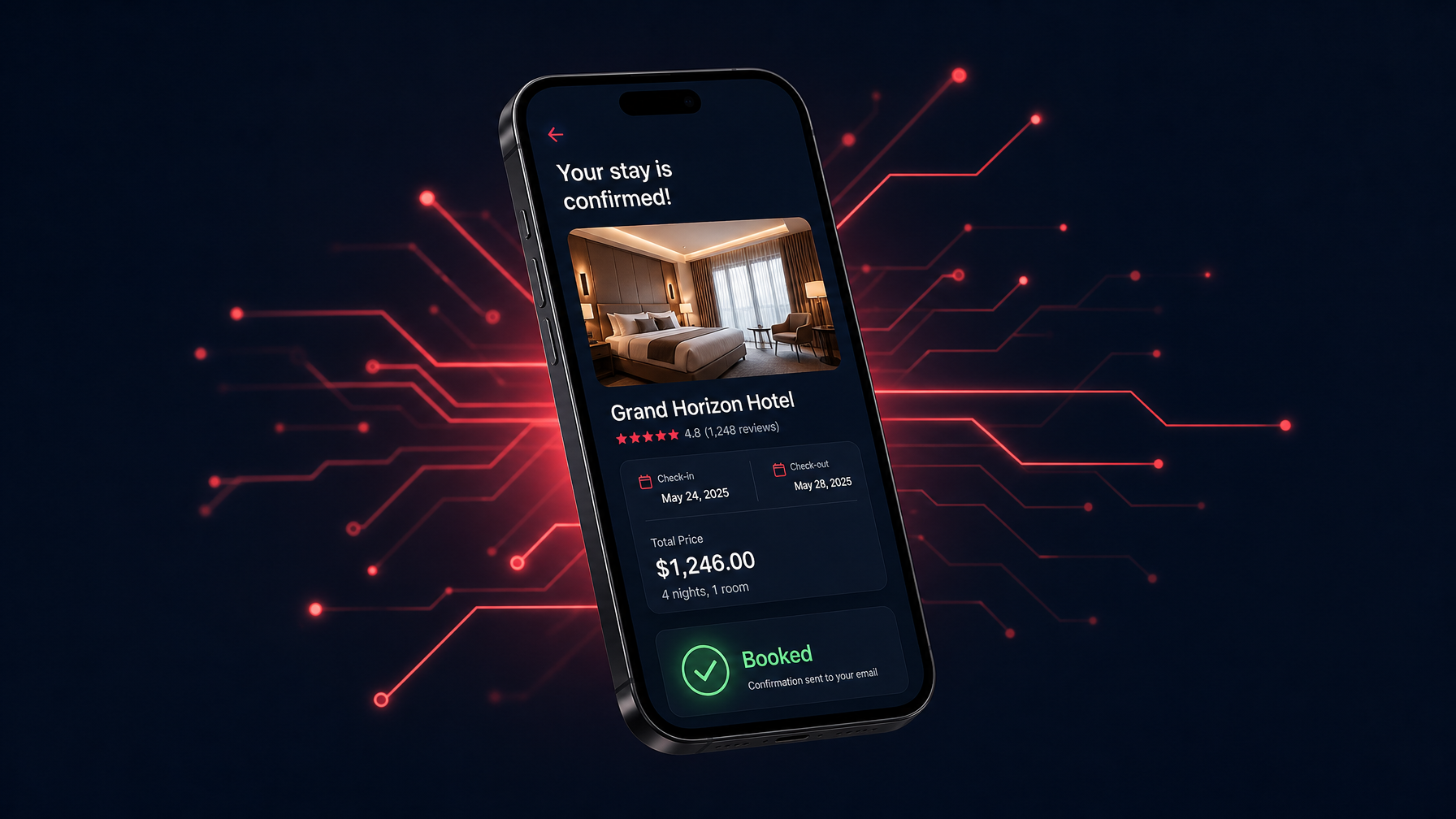
Yes. A completed AI hotel booking works like any other hotel reservation. You receive a confirmation with booking reference, check-in details, and cancellation policy.
Can I cancel or modify an AI booking?
Cancellation and modification policies depend on the rate you selected — the same as any other booking method. The AI surfaces cancellation terms before you confirm, so you know what you're agreeing to.
Does AI hotel booking work internationally?
Yes. AI hotel booking apps with live inventory access work globally. You search in natural language — "hotel in Tokyo" works the same as "hotel in Austin."
Why do some "AI travel tools" not actually book?
Most AI travel tools were built around language models that generate suggestions, not around live booking infrastructure. Actual hotel booking requires real-time API connections to inventory systems. That's a different technical build, and most general-purpose AI assistants don't have it. Apps built specifically for hotel booking — like BookingGPT — are designed around that live connection from the ground up.
The Bottom Line
Booking hotels with AI in 2026 means something concrete: describe what you want, get real options at real prices, confirm in seconds. It works for advance bookings, it works for last-minute rooms, and it works internationally.
The gap between this and the old Booking.com / Expedia experience isn't subtle. One asks you to do the work. The other does the work for you.
If you want to try it yourself, download BookingGPT — available on iOS and Android. Type what you want. See what happens.