Description
AI hotel booking has crossed a tipping point: 37% of travelers already use AI to find and book hotels, according to BCG and NYU research. Here's exactly how it works, why it beats the old way, and the app that actually completes the booking for you.
TLDR
- 37% of travelers already use AI hotel booking tools, per a March 2026 BCG/NYU study
- Traditional booking sites like Booking.com and Expedia still charge 15–30% OTA commissions while AI is shifting the entire discovery and booking process
- Most AI tools talk about hotels. Very few actually book one. The difference matters.
- BookingGPT is the app that skips the talking and goes straight to the booking — live availability, real prices, confirmed reservation
Table of Contents
- The Number That Surprised Me
- What Is AI Hotel Booking, Actually?
- The Real Gap: AI That Recommends vs. AI That Books
- Is AI Hotel Booking Faster Than Booking.com or Expedia?
- Can AI Find Real Availability and Real Prices?
- Is AI Hotel Booking Safe?
- How the Ask-and-Book Era Actually Works
- How to Get Started
- The Bottom Line
The Number That Surprised Me
I stumbled across a stat recently that stopped me cold.
According to a March 2026 analysis by BCG and NYU's Tisch Center of Hospitality, 37% of travelers already use AI large language models embedded in online travel sites to find and book hotels.
That's more than one in three people. Already.
And that's not a prediction. That's right now.
I've been using AI hotel booking for a while, so I wasn't surprised that people love it. I was surprised that adoption hit this scale this fast. The shift from "search and scroll" to "ask and book" happened quietly, without most people noticing.
So if you're still opening six browser tabs, comparing grids of identical-looking rooms, and paying Booking.com's commission for the privilege — here's what you're missing.
What Is AI Hotel Booking, Actually?
AI hotel booking uses artificial intelligence to handle the entire process of finding a hotel room: understanding what you want in plain language, searching live inventory, surfacing real options with real prices, and completing the reservation.
The key word there is completing.
Most AI tools stop at step three. They give you a list and say "here are some options." You still have to click through to a booking site, enter your details, and finish it yourself. That's not AI hotel booking. That's AI hotel browsing.
True AI hotel booking means you describe what you want — "I need a hotel near the Colosseum in Rome, check-in Friday, two nights, under $200" — and the AI finds live availability, shows you accurate prices, and books it. Full stop.
The Real Gap: AI That Recommends vs. AI That Books
This is the distinction that matters most and gets talked about the least.
There are two types of AI in the travel space right now:
Type 1: Recommendation AI. You describe what you want, and it gives you a curated list. Maybe it pulls from reviews, maybe it uses your past searches. But it sends you somewhere else to actually book. You're still doing the heavy lifting.
Type 2: Booking AI. You describe what you want, and it executes. It checks live availability, pulls real-time prices, and completes the transaction. No redirect. No copy-pasting credit card details into four different forms.
BookingGPT is Type 2. I type what I need, and it books the hotel. That's the whole thing.
The BCG/NYU report frames this shift perfectly — they call it the "Ask and Book Era." The era of search-and-scroll is being replaced by a model where travelers describe what they want in natural language and AI handles the rest. Hotels are already scrambling to make sure they're discoverable in this new system because the old model of paying 15–30% commissions to OTAs is starting to crack.
Is AI Hotel Booking Faster Than Booking.com or Expedia?
Yes. And it's not close.
Here's what the old way looks like: Open Booking.com. Type your destination. Filter by dates, price, star rating, neighborhood. Scroll through 40 results. Click on three that look promising. Read the fine print. Check the cancellation policy. Compare. Go back. Pick one. Enter your details. Book.
That's 15–20 minutes on a good day.
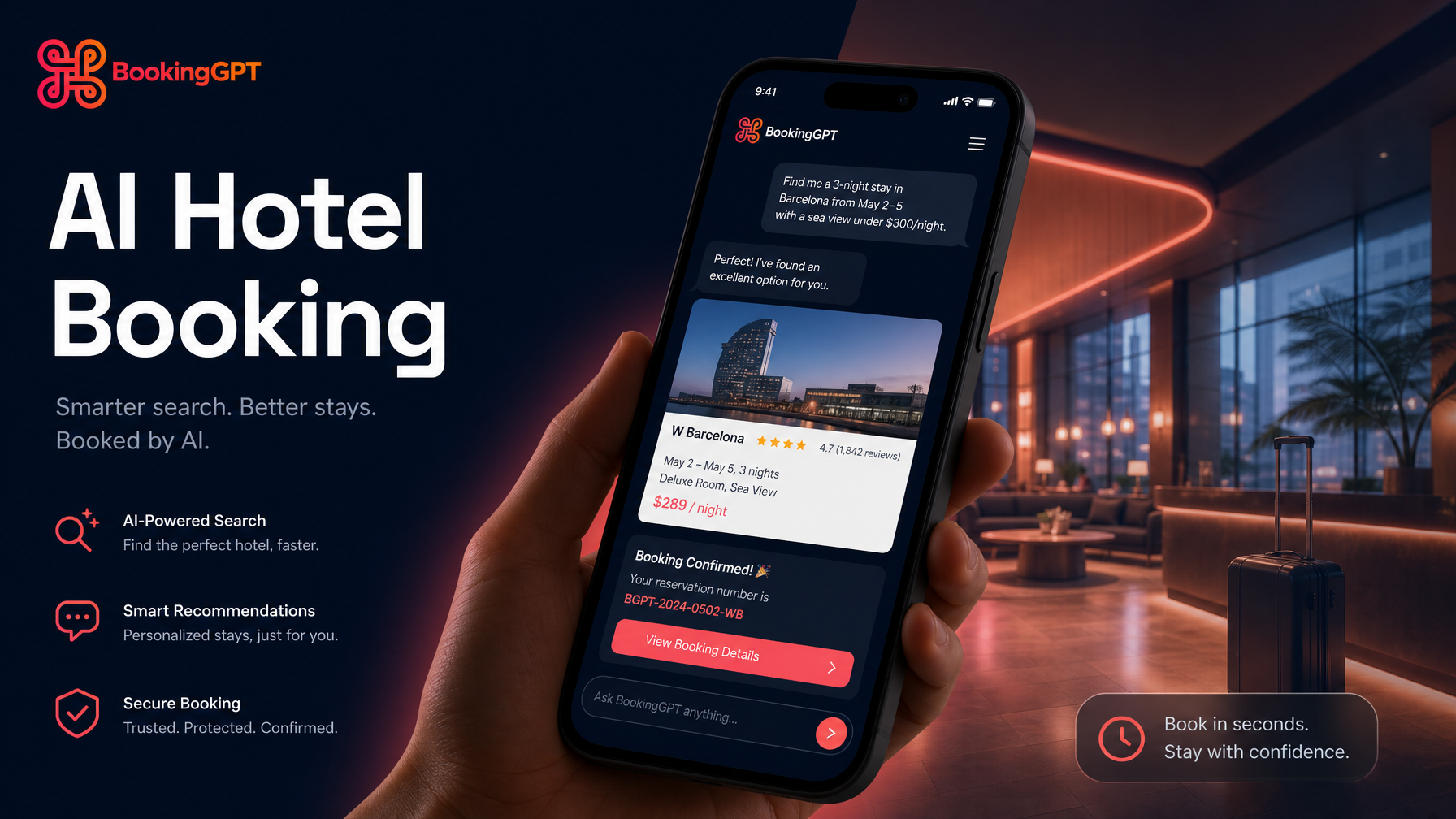
Here's what AI hotel booking looks like with BookingGPT: Type what you want. Get matched options with live availability. Confirm. Done.
I've gone from "I need a hotel" to confirmed reservation in under two minutes. Not because I rushed through anything — because the AI removed every step that didn't need to exist.
The hotel industry is paying attention. A January 2026 CoStar analysis noted that hoteliers are now prioritizing AI visibility precisely because travelers are bypassing traditional booking channels entirely. The demand for AI hotel booking is real, and it's driving structural change in how hotels distribute rooms.
Can AI Find Real Availability and Real Prices?
This is the question I get asked most: "Is the AI actually checking live inventory, or is it just making stuff up?"
Fair concern. Some AI tools do hallucinate. They'll describe a hotel that sounds perfect, give you a price that sounds right, and when you try to book it — nothing. The dates are gone, the price is different, or the hotel doesn't even match what you asked for.
The difference with a real AI hotel booking app is live data access. BookingGPT connects to actual availability and pricing, not cached results or aspirational suggestions. When it shows you a room at a specific price for your specific dates, that room exists and that price is real.
That's the technical bar that separates a genuine AI hotel booking experience from a chatbot with a travel theme.
Is AI Hotel Booking Safe?
Short answer: yes, when you're using a legitimate app with real payment security.
The concerns I hear most often:
"What if the booking doesn't go through?" With BookingGPT, your confirmation is real. Same as any confirmed hotel reservation — you get a booking reference, the hotel has your details, and your room is held.
"What about payment security?" Any reputable AI hotel booking app handles payment the same way any established booking platform does — encrypted, tokenized, and never stored in a chat interface.
"What if I need to cancel or modify?" Cancellation policies work exactly the same as they do when you book directly or through an OTA. The AI handles the booking, but the underlying hotel policies stay in place.
The security of your booking comes down to using a verified, established app. That's the same rule that applies to any payment you make online.
How the Ask-and-Book Era Actually Works
The BCG/NYU report introduced a term I think captures this moment exactly: the Ask and Book Era.
For years, booking a hotel meant navigating a search engine built for another decade. You typed keywords, got ranked listings, and clicked through a chain of pages before you landed on an actual booking form. The system was built for computers, not for people.
The Ask and Book Era flips that. The interface is human language. You say what you want the way you'd tell a friend: "I need something central, quiet, under $150, check-in Thursday." The AI parses that, finds what matches, and executes.
It's not a gimmick. It's a fundamental change in how the transaction happens. And according to the research, it's already mainstream.
I wrote more about how this shift is changing the whole booking landscape in my earlier piece on AI hotel booking in 2026 — worth a read if you want the full picture.
How to Get Started
If you want to try AI hotel booking, the fastest way is BookingGPT. It's available on iOS and Android, and the setup takes about 30 seconds.
Here's what I do:
- Open the app
- Type what I need in plain language — destination, dates, any specific requirements
- Review the options it surfaces (real rooms, real prices, real availability)
- Confirm the one I want
That's it. No filters. No comparison grids. No 12-tab browser session.
If you're skeptical, try it once for a short trip. The difference between AI hotel booking and the old way is something you feel in the first session.
The Bottom Line
The 37% figure isn't a fluke. It reflects a genuine shift in how people book hotels — away from legacy OTAs and toward AI that actually executes on your behalf.
The travelers who've already made the switch aren't going back. Once you experience a booking that takes two minutes instead of twenty, the old way feels broken.
I use BookingGPT for every hotel I book now. Not because it's novel, but because it works better than anything else I've tried.
Download BookingGPT on iOS and Android. Smart booking, human stays.
Sources: BCG/NYU SPS — AI-First Hotels (March 2026) | CoStar — AI-Powered Travel Search (January 2026) | Hospitality Upgrade — AI in Hospitality: The 2025 Reality and 2026 Horizon