Description
Everyone is shipping an AI travel app in 2026. Most still hand you a shortlist and a link out. Here’s what actually counts when you want the app to finish the hotel booking for real.
Most AI Travel Apps Still Dump You on a Booking Site. I Stopped Settling for That.
#TLDR: An AI travel app should do more than chat about destinations. Live rates, real availability, and a confirmed hotel stay in the same flow. Big brands added conversational discovery this year. Many still bounce you to a separate site to pay. I use BookingGPT when I want the booking to finish inside the conversation.
Table of Contents
- What people mean by AI travel app
- Why the category exploded in 2026
- The gap nobody puts on the App Store screenshot
- What the big players actually shipped
- The test I run on every AI travel app now
- What end-to-end feels like
- Download BookingGPT
What people mean by AI travel app
Type "AI travel app" into any store and you get a wall of chat bubbles. Some write packing lists. Some rank neighborhoods. Some spit out day-by-day schedules you still have to rebuild on Booking.com or Expedia by hand.
That last part is the whole story.
When I say AI travel app, I mean a tool that takes a plain-language request ("boutique hotel in Lisbon near LX Factory, under $200, late check-in") and returns live inventory with real prices, then lets me lock the room without opening five new tabs. Inspiration is nice. A confirmation email is better.
If the product only talks and never books, it is a chatbot with a travel skin. Useful for ideas. Useless at 11pm when you need a bed tomorrow night.
Why the category exploded in 2026
Traveler behavior already moved. NYU SPS and Boston Consulting Group found that 37% of travelers already use AI large language models embedded in online travel sites to search and book. Their report frames hotel discovery as a shift from "search and scroll" to "ask and book."
Accenture’s Consumer Pulse Research, cited in the Radisson Hotels ChatGPT launch, says 87% of travelers are open to collaborating with an AI-powered travel agent, and 71% say at least half of their hotel or airline spend will be influenced by AI over the next 12 months.
PhocusWire’s write-up of Accenture’s broader Consumer Pulse work adds another signal: for active gen AI users, generative AI is the number-one go-to channel for travel discovery, ahead of classic OTAs and social. More than half of travelers in that research say they are ready for AI agents to handle full booking work.
So demand is real. The product question is simpler: does your AI travel app stop at discovery, or does it complete the stay?
The gap nobody puts on the App Store screenshot
I have written about this problem before, from the hotel-chain handoff angle and from downloading a stack of AI travel apps. The pattern does not change.
- You describe what you want in natural language.
- The app returns a pretty shortlist.
- You tap "Book" and land on another website, another login, another form.
That third step is the old way of doing things with a conversational front door. AFAR’s hands-on review of AI travel tools put it plainly: after you refine the chat, you still use the links the tools provide to book your trip on someone else’s site (AFAR). Kayak-in-ChatGPT, Gemini, and similar flows shine at research. Checkout still lives elsewhere.
An AI travel app that cannot close the hotel reservation is a research assistant. Call it what it is.
What the big players actually shipped
Hotel brands inside ChatGPT. Radisson Hotel Group with Accenture launched @RadissonHotels so you can ask for a family weekend in Amsterdam or a Paris stay near the Eiffel Tower with a gym. You get live inventory and rates across 1,000+ hotels in 100+ countries. When you are ready, travelers are directed to complete the reservation through the Radisson Hotels website. Discovery in chat. Booking on the brand site. IHG’s conversational app follows the same shape: strong natural-language search, completion on IHG digital channels (IHG).
Super-apps adding hotels. Uber’s April 2026 Go-Get launch put hotel bookings in the Uber app through an Expedia integration (700,000+ options for U.S. users), plus AI voice booking for rides. That is a real distribution move. It is still filter-and-list hotel shopping next to rides, not "type one sentence and confirm the room in the same thread."
The classic OTAs. Booking.com and Expedia remain the default checkout layer half the industry deep-links into. Fast at inventory. Slow at conversation. They are the old way of doing things for a reason: they close the transaction. Most "AI travel app" wrappers still depend on them at the last click.
None of this is fake progress. Live rates in chat matter. Maps and loyalty points matter. The missing piece is still the same: one continuous path from sentence to confirmed hotel.
The test I run on every AI travel app now
Before I trust a download, I run four checks. No hype. No feature bingo.
- Live availability. Does it show rooms that exist for my dates, or generic "great hotels in Rome" filler?
- Real prices. Can I see a total I could actually pay, not a "from" teaser that dies at checkout?
- Constraints in one prompt. Budget, neighborhood, amenities, check-in time. Does the model hold all of them, or drop half?
- Book without a bounce. Can I confirm inside the product, or do I get exported to Booking.com, Expedia, or a brand site to finish?
Fail #4 and the first three are theater. I covered that handoff problem in depth when every major "book hotels with AI" flow redirected at the last step. Same test. Same failure mode across half the category.
Pass all four and you have an AI travel app worth keeping on the home screen.
What end-to-end feels like
I stopped juggling twenty tabs the day the flow got boring in a good way.
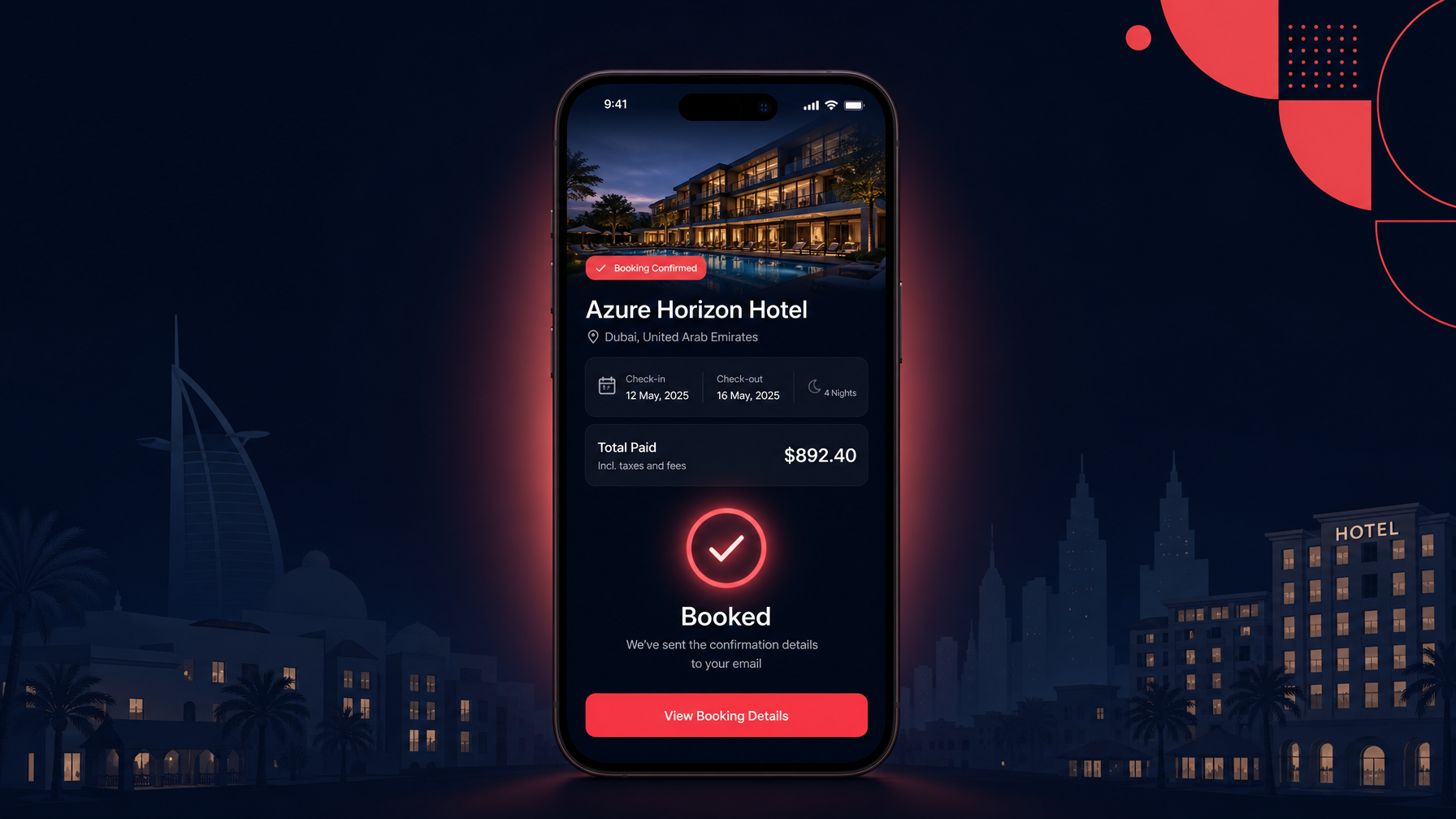
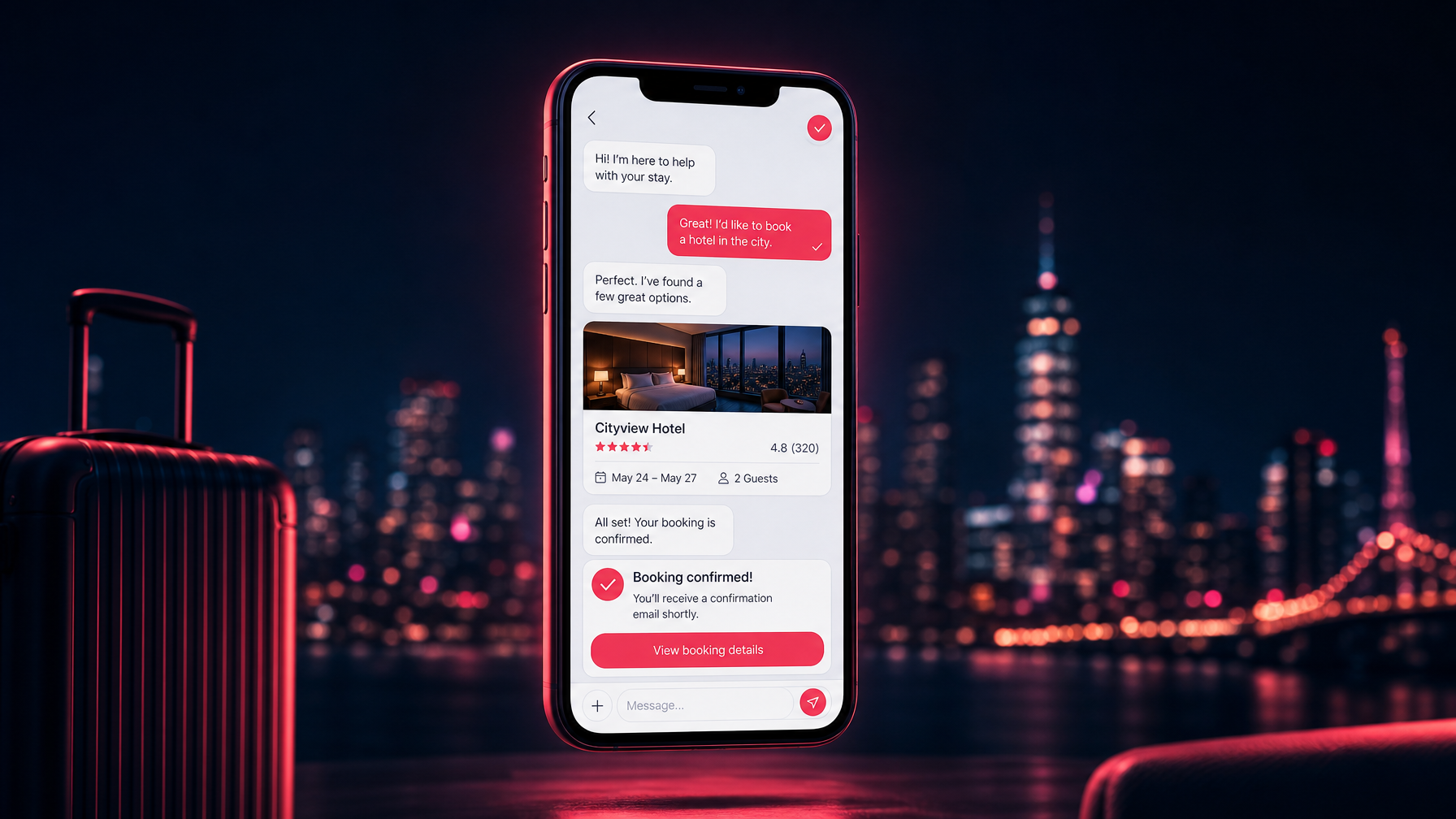
I open BookingGPT. I type what I need the way I would text a friend who actually knows hotels. The AI pulls live availability and real prices. I pick a room. I confirm. Done.
No second site. No re-entering dates. No "complete booking on our website" trap.
That is the product bar for an AI travel app in 2026 if the job is a hotel stay, not a mood board. BookingGPT is built for that job: AI that finds live rooms and completes the booking, on iOS and Android. Smart booking, human stays.
If you want the longer version of how this differs from tab chaos, I walked through AI hotel booking without the twenty-tab circus earlier this cycle.
Download BookingGPT
An AI travel app should not end with "here are some links." It should end with a reservation.
If you are done with chatty shortlists that dump you on another checkout page, download BookingGPT and book the room in the same conversation.
Get BookingGPT, free on iOS and Android. Type what you want. See live rates. Book in seconds.