Description
AI hotel booking is everywhere in 2026. But most of it is search dressed up as booking. Here's what actually separates a real AI hotel booking experience from the theater.
I Spent a Week Trying to Book Hotels Using AI. Most of It Was Theater.
#TLDR: In 2026, nearly every platform. Google, Uber, Expedia, Booking.com, Priceline. Claims to offer "AI hotel booking." Almost none of them actually complete the booking through AI. They search. They suggest. They hand you off to a checkout page. Real AI hotel booking means the AI finds live availability, confirms real prices, and executes the reservation. That's a different product. Most of what's being marketed right now isn't it.
Table of Contents
- The promise vs. what I actually experienced
- What is AI hotel booking, really?
- Does ChatGPT actually book hotels?
- What about Google's agentic booking?
- Is Priceline's AI assistant doing real booking?
- Where does that leave travelers who just want a room?
- What the future of AI hotel booking actually looks like
- The app that actually does it
The promise vs. what I actually experienced
Every tab in my browser this summer had some version of "AI hotel booking" in the headline.
Google launched agentic booking. Uber added hotels. Priceline debuted an AI assistant. Airbnb added AI-powered search tools for boutique hotels in its 2026 Summer Release. Marriott publicly announced it's working with Google on an agentic AI booking tool, per Skift's February 2026 report.
So I spent a week actually trying to use AI to book hotels across different platforms.
Here's what I found: the experience consistently fell into one of two categories.
Category 1: The AI understood my request, returned a smart list of options, and then redirected me to a checkout page where I filled in the same fields I always have.
Category 2: The AI got confused about pricing, couldn't tell me specific room names, or locked key details inside a visual interface it couldn't read back to me.
What I was not able to find. At least not in the "AI hotel booking" features of platforms I'd already been using. Was an AI that completed the booking.
That's the gap this post is actually about.
What is AI hotel booking, really?
The phrase "AI hotel booking" gets used to describe two very different things, and the difference matters a lot if you're the one trying to get a room.
AI-assisted hotel search is what most platforms offer. You describe what you want in plain language. The AI finds relevant results. You click through to a traditional booking flow to finish. This is useful. It's a smarter filter. But it doesn't change the fundamental transaction: you're still doing the booking yourself.
AI-executed hotel booking is what the name implies. You describe what you want, the AI checks live availability, confirms real prices, and completes the reservation. No redirect to a checkout page. No entering your card details for the fourth time this month. The AI executes the booking.
Most platforms marketed as "AI hotel booking" in 2026 do the first thing. A very small number do the second.
That distinction is the whole ballgame.
Does ChatGPT actually book hotels?
Sort of. With significant caveats.
In February 2026, travel industry analyst Michael J. Goldrich tested three ChatGPT travel booking integrations side by side: Expedia, Booking.com, and Accor. His findings are worth reading in full, but the short version is this:
Expedia delivered the most polished conversational experience. Hotel names, descriptions, and comparisons with pricing appeared inside the chat. Booking.com landed in a confusing middle zone where the rates the AI quoted didn't always match what the visual interface showed. Accor's integration was the least conversationally functional but made a strategically interesting choice: it linked directly to the hotel's own booking platform instead of routing through an OTA.
What none of them did: book the hotel.
The deeper friction Goldrich identified was even more fundamental. To use any of these integrations, you have to stop your conversation, navigate to the ChatGPT app directory, find the specific travel app, install it, and then attach it to your chat session. As he put it, the experience is "the opposite of how conversational AI is supposed to work."
You're chatting about finding a hotel room. At some point, you have to pause and go install a connector. Most people won't. They'll open a browser instead.
That's not AI hotel booking. That's a very elaborate search tool with extra steps.
What about Google's agentic booking?
Google's agentic booking layer is real, and it's the most technically interesting development in the space right now. Google's AI can receive a hotel request, process it, and route the reservation. All within a single interaction.
The catch: according to Hospitalitynet's May 2026 analysis, Google's agentic AI routes bookings through Booking.com and Expedia rather than routing around them. The AI adds a new layer on top of existing OTA checkout flows. Better discovery. Same checkout.
So Google's agentic booking gives you a smarter front door to the same old Booking.com or Expedia page you already know. That's not nothing. But it's not the same as AI completing the transaction.
Marriott is working toward something more direct. Skift reported in February 2026 that Marriott is the first major hotel chain to publicly discuss building an agentic AI booking tool with Google that would process reservations, not just search them. That's meaningful. It's also still in development.
Is Priceline's AI assistant doing real booking?
Priceline's AI assistant, Penny, launched as a tool for both search and post-booking support. CX Dive's June 2026 profile of Priceline's agentic AI strategy describes Penny as focused on "making the hotel decision easier". Surfacing comparisons, flagging deals, helping customers think through options.
That's search enhancement, not booking execution. Penny helps you decide. You still click to confirm.
Where does that leave travelers who just want a room?
In a genuinely confusing place.
Every major platform is calling its features "AI hotel booking." Very few of them are completing the booking through AI. BCG's March 2026 analysis of AI adoption in hospitality found that fewer than 10% of hospitality companies surveyed could be described as "future built" for AI-first operations. The industry is mid-transition, and the gap between what's being marketed and what's actually working is wider than most coverage acknowledges.
Hotel technology firm Mews put it bluntly in their 2026 Hospitality Industry Outlook: by 2035, most hotel discovery and booking will happen through a single AI conversation. But 2026 is described as a "preparation year". The infrastructure and the habit are still forming.
That prediction is probably right. The question is what you use in the meantime, while the major platforms are still catching up.
What the future of AI hotel booking actually looks like
The destination is fairly clear: you describe what you need. City, dates, vibe, budget. To an AI, and the AI finds real rooms at real prices, then confirms the reservation. One conversation. No redirects. No checkout page.
The gap between that vision and what most platforms deliver in 2026 is not a technology limitation. It's an architecture one. Platforms built around legacy OTA infrastructure are layering AI on top of existing checkout flows. They can make search smarter. They can't make checkout disappear, because the checkout is how their business model works.
An AI-first hotel booking product doesn't have that constraint. It's built around the execution, not the search. The AI is the checkout.
That's a different product category. Even if the marketing language for both sometimes sounds the same.
The app that actually does it
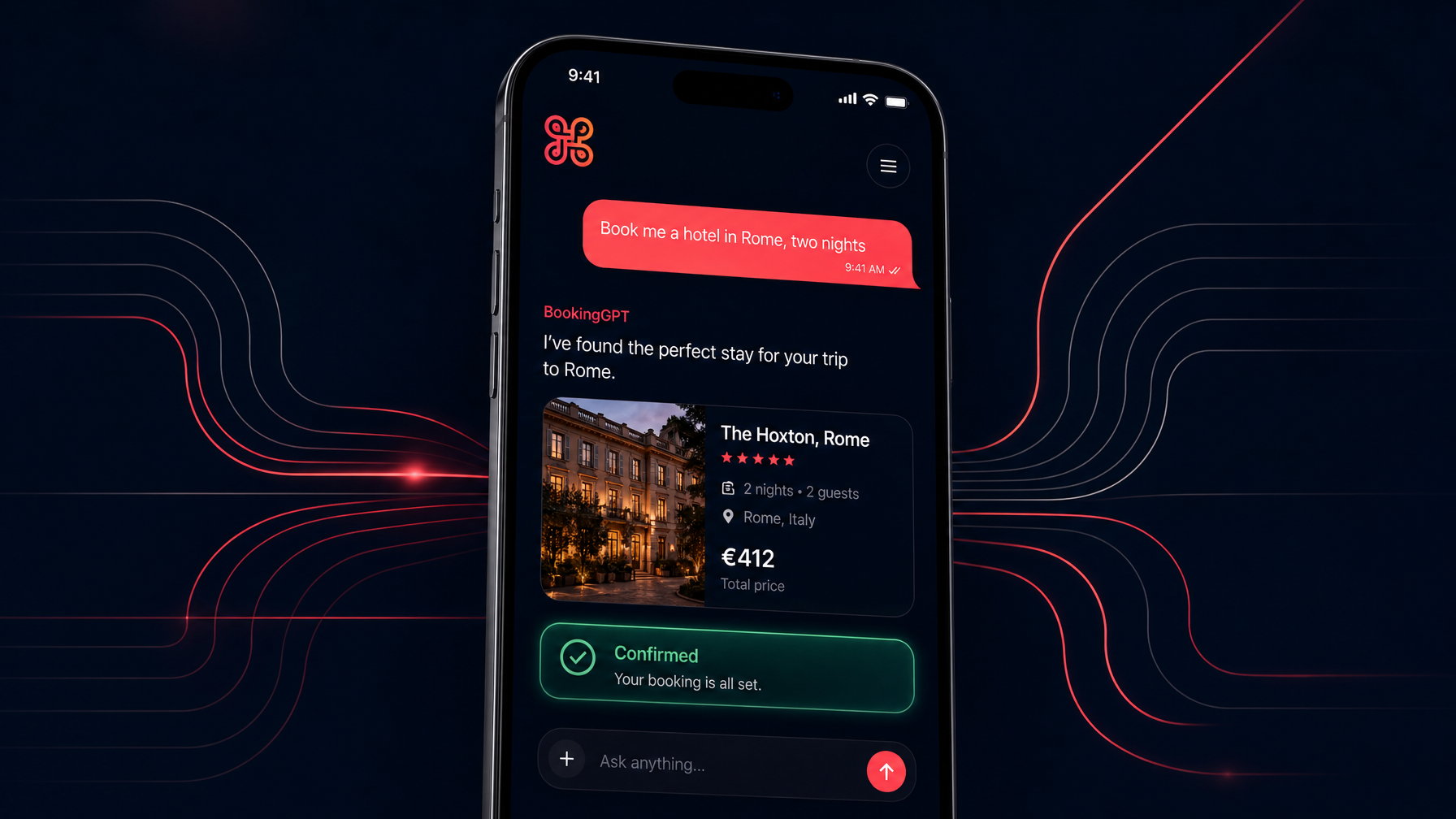
I typed "quiet hotel under $200 in Lisbon, check in Friday" and had a confirmed reservation in seconds.
No redirect. No checkout page. No comparison grid I had to manually filter.
That's what I've been using BookingGPT for. It's an AI hotel booking app. IOS and Android. Built specifically to execute bookings, not just surface them. Real availability. Live prices. The AI confirms the room.
If you're spending time clicking through Booking.com or Expedia filters, comparing tabs, re-entering your card details. There's a better way to get a room now.
Download BookingGPT on iOS or Android and try it on your next hotel search.